Health Providers Concerned About Perram House Closing

Posted on April 13th, 2013 by kpdorman.

Letter from Nurse Practioner, Anne Edger, to MPP Glen Murray

April 9, 2013

To: Honorary Glen Murray, MPP for Toronto Centre

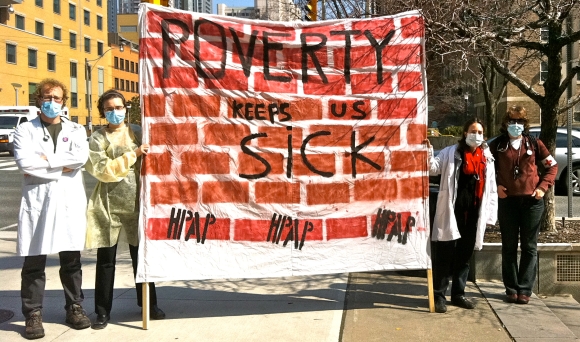
I am writing on behalf of members of Health Providers Against Poverty (HPAP) and Street Nurses Network (SNN), two organizations committed to addressing issues of people living in poverty. We are alarmed and deeply concerned at the news that Perram House is closing.

Many of us have come to know well the excellent end of life care that Perram House has set up to do in the past eight years for the most marginalized and low-income individuals in downtown Toronto.

Personally, I recall when the search for a palliative care, home hospice facility and concept was being elaborated nearly ten years ago as so many of our patients would have no place to go in their dying days; the search for a place that provided dignity, compassion and an understanding of such a population’s challenges.  Over the years, Perram House filled that void. I have been at the bedside of dying patients or visited them as they sat on the terrasse when they still could.  They were at peace when they reached Perram House and knowing that our patients were provided with excellent end of life care in such a wonderful facility was truly a blessing.

If Perram house closes, this would represent a huge loss for the most vulnerable and marginalized members of our society. Already shunned throughout their lives, our patients would continue to face stigma, isolation, pain and fear. No one deserves this. Loosing Perram House is unthinkable and such a facility is essential in Toronto and its varied populations.

We strongly hope that the labour situation is dealt with in a fair and equitable manner and Perram House can continue to do its excellent work.

Sincerely,

Anne Egger, RNEC
Nurse Practitioner, Member of Health Providers Against Poverty and Street Nurses Network

More Information:

Perram House Hospice Closing Wednesday; Staff Got Two Days Notice
The Toronto Star - April 10, 2013


City of Toronto Welcome Policy - Recreation Subsidy

Posted on April 10th, 2013 by kpdorman.

City of Toronto Welcome Policy - Recreation Subsidy for Low-Income Individuals and Families

The City of Toronto's Welcome Policy provides a fee subsidy to help low income individuals and families who live in Toronto access City-operated recreation programs. If you are approved for the program, you will receive an annual financial subsidy that can be spent on any of the wide variety of recreation progrms offered by the City. 

Toronto residents receiving social assistance automatically meet the income requirements and should speak to their caseworker about the Welcome Policy. 

To obtain a Welcome Policy Application, call 416-338-2000, visit a City of Toronto recreation centre, or download it here.

Learn more about the program here!

We encourage Toronto health care providers to inform their patients about this program!


News: Toronto School Survey

Posted on April 10th, 2013 by kpdorman.

Toronto School Children of Low-Income Families More Likely to Suffer Anxiety, Survey Finds

The Toronto Star, April 5 2013

Low-income children are more likely to seem anxious, in a bad mood and complain of stomach pains or headache than their more affluent classmates, according to a survey of nearly 90,000 elementary students by the Toronto District School Board.

As well, the survey shows that the majority of all visible minority students are also in the lowest two income brackets.

But more children living below the poverty line also now say they feel treated with respect in school than they felt four years ago, and more of their parents now come to teacher meetings.

“This is a huge increase and what makes us happy is that we’re reducing the gap between income groups; we’re having an equalizing effect,” noted research co-ordinator Maria Yau. The survey is the most detailed conducted by any school board in the province and was filled in by parents of children from kindergarten through Grade 6.

The results, released Friday by the board, paint a picture of a highly diverse student body, of whom the largest group — 29 per cent — identify themselves as white, followed by 26 per cent South Asian, 14 per cent East Asian, 10 per cent black, with other groups in smaller numbers.

But fully 49 per cent come from families whose annual incomes are no more than $49,000, with more than one in four children living below the poverty line of about $30,000.

It is those children who are least likely to have attended a preschool program or to take part in the after-school sports and recreation programs and arts activities that can enrich students’ lives....

Read more here.

Article: Paediatric Palliative Care and the SDOH

Posted on April 6th, 2013 by kpdorman.

Paediatric Palliative Care and the Social Determinants of Health: Mitigating the Impact of Urban Poverty on Children With Life-Limiting Illnesses

Pediatric Child Health, Vol 18, No 4, April 2013

Toronto-based health care providers and researchers call for increased research on the impact of poverty on children with life-limiting illnesses. In an epidemiological five-year review of Toronto children who were followed by palliative care at a paediatric hospital, the authors found that 62% of these families lived in a high-poverty neighbourhood.  The authors highlight the significant emotional, social, and financial impact on families in this situation, with even greater hardship being experienced by low-income, single-parent, and newly-arrived immigrant families.  Low-income families caring for sick children have the added stress of paying for medications that are not covered, paying utility bills, feeding the family, applying for financial programs that they may or may not be eligible for, finding work that accomodates the child's medical appointments and 24 hour care, and finding housing that works as a home-hospital setting. 

The authors include A Financial Assessment and Resource Guide for Children With Complex Medical Conditions, adapted from the Child Poverty clinical tool developed by Morinis, Bloch, Ford-Jones, and Levin in collaboration with the Social Paediatrics Working Group in Toronto, 2012. 

Call-Out: Join HPAP at a Rally to Demand Shelter Space

Posted on March 25th, 2013 by kpdorman.

Community Meal and Rally to Demand Shelter Space! 

This coming Thursday, OCAP will be hosting a community meal and rally at Metro Hall in the lead-up to the City Council Meeting on April 3, 2013, in order to show that the demand for new shelter space is a broad-based community demand that cannot be ignored. 

1) Community Meal and Rally - Thursday March 28 at 6pm, Metro Hall 
2) All Out to City Council - Wednesday April 3 at 9:30am, Toronto City Hall

More Information: http://ocap.ca/node/1071

Recent Media On Toronto Shelters:
City committee votes to open up more shelter beds
NOW Toronto - March 18, 2013
Two inconvenient truths about Toronto's shelter system
The Toronto Star - March 19, 2013


Editorial: As A Doctor, Here's Why I'm Prescribing Tax Returns

Posted on March 20th, 2013 by kpdorman.

As A Doctor, Here's Why I'm Prescribing Tax Returns
The Global and Mail - March 20, 2013
By Gary Bloch

Tax season is upon us and my practice is humming. I am not an accountant, I am a family doctor. My patients are not bank executives, they are largely people who live in poverty, many who are homeless and on social assistance. Yet I have set out to remind my patients – each and every one of them – to fill out their tax returns.

Is this a case of confused professional identity? Have I confused RRSPs with ECGs? I don’t think so. This is a powerful health intervention.

Rena, a patient of mine who suffers from high blood pressure, chronic back pain and depression, and with whom I have spent countless hours, once said to me, “Doc, if you really want to make me better, get me more money.”

Rena works full time at a minimum wage job, earning just under $20,000 a year. With this, she does her best to support herself and her young daughter. However, she has not always been diligent in filing her tax returns. If she had, she could have received over $8,000 more a year in tax credits from the provincial and federal governments. That might have gone a long way to make things just a little bit better for her, including her health.

Suggesting Rena fill out her tax return is prescribing income. And prescribing income can be just as powerful as prescribing medications for her blood pressure or her mood.

This approach is grounded in evidence.

The link between health and income is solid and consistent – almost every major health condition, including heart disease, cancer, diabetes, and mental illness, occurs more often and has worse outcomes among people who live at lower income. As people improve their income, their health improves. It follows that improving my patients’ income should improve their health.

There is evidence that this approach to delivering health care works. Family practices in the U.K. have worked with “welfare rights advisors” for two decades. These advisors focus on helping low income patients access the income benefits they are due. These programs have been shown to improve patients’ income and sense of wellbeing in the short-term studies that have been conducted so far.

Closer to home, a study conducted in Dauphin, Man., in the 1970s, recently analyzed by health economist Evelyn Forget, showed that an income supplement offered to an entire town reduced hospital visits, birth rates, and hospitalizations for mental illness, accidents and injuries.

It is true that the most meaningful answer to addressing poverty lies in much larger scale interventions than my attempts to have my patients fill out their tax returns. In fact, the same can be said for many conditions we treat. We can combat heart disease with cholesterol and blood pressure medication, but what about reducing saturated fats in processed foods? Diabetes can be improved with metformin and insulin, but what about decreasing access to sugary drinks?

We do our best to treat each patient and their illness in our own practices while advocating for broader policy change. The same approach is necessary for fighting poverty. As doctors we need to, and we can, prescribe income while advocating for real, effective policies to combat poverty.

I will continue to advise my patients to exercise more and eat healthier food, but this tax season I will also spend time prescribing tax returns. Income is a powerful determinant of health – more so than many medications I prescribe. I will do my part to make it a positive force in the health of my patients.

Gary Bloch is a family physician with St. Michael’s Hospital in Toronto, and the chair of the Ontario College of Family Physicians’ Committee on Poverty and Health. He is an expert advisor with EvidenceNetwork.ca.

http://www.theglobeandmail.com/commentary/as-a-doctor-heres-why-im-prescribing-tax-returns-seriously/article9981613/

News: Committee Recommendations On Toronto Shelters

Posted on March 19th, 2013 by kpdorman.

Frontline workers report that individuals are frequently denied shelter beds in Toronto. Even more unsettling, the number of deaths among homeless individuals increased dramatically in 2012. 

In response, the Ontario Coalition Against Poverty (OCAP) organized an emergency meeting on February 15th 2013. HPAP members joined as OCAP set up an "emergency shelter" in front of the Mayor's office in Toronto City Hall. 

On March 4th 2013, the Shelter, Support, and Housing Administration issued an Update on Emergency Shelter Services to the Community Development and Recreation Committee.

Subsequently, on March 18th 2013, the Committee heard from frontline workers, community members, and city councillors concerned about the increasing number of individuals being turned away from shelter beds in Toronto. HPAP member, Anne Egger, shared her concerns regarding the current state of Toronto's emergency shelter services in a letter to the committee. 

The Toronto Star article, Two Inconvenient Truths About Toronto's Shelter System, summarizes some of the barriers that individuals trying to access a shelter encounter.  

CMA Report: Physicians and Health Equity

Posted on March 18th, 2013 by kpdorman.

Physicians and Health Equity: Opportunities in Practice

A recent report by the Canadian Medical Association provides strategies that physicians can use to address health equity within their practices. It also highlights a key role for national medical groups in advocating for policies that reduce disparities in the social determinants of health.

Poverty represents a serious but reversible threat to the health of Ontarians. As health providers we enjoy privilege and access to power which many others do not. As a high-impact health intervention, we will work to eliminate poverty.